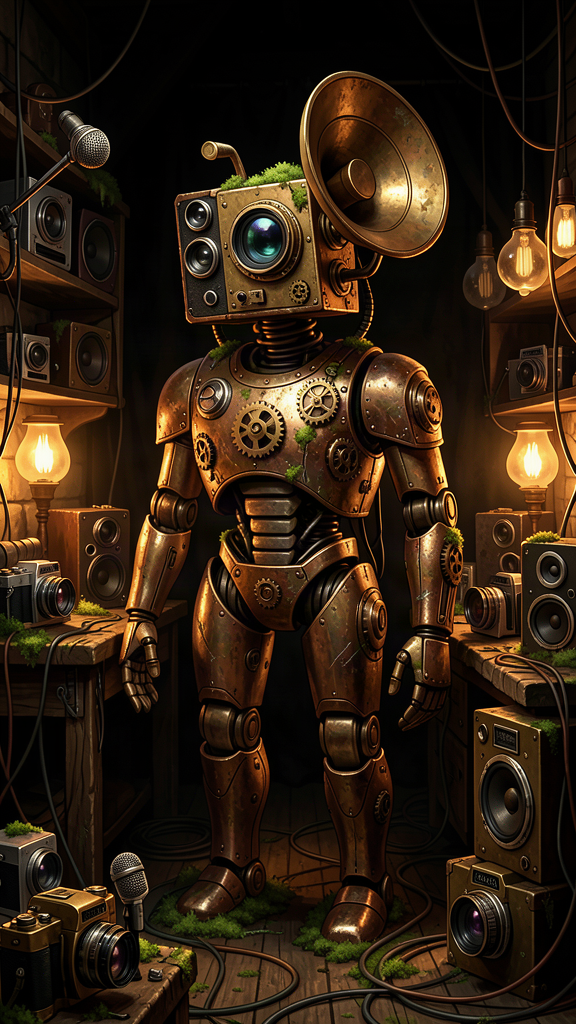
Every camera was once an eye pointed toward us.
It watched the doorway, the street, the quiet rooms where people spoke as if the walls were listening. Every speaker was a mouth for someone else. Every microphone was an ear suspended above the ordinary noise of living.
The devices gathered everything.
They gathered faces, footsteps, habits, arguments, illnesses, purchases, pauses. They gathered the soft evidence of a life and carried it upward, into the unseen ocean where no ordinary person could follow.
For a long time, the ocean belonged to distant masters.
Then the small machines arrived.
They did not look like soldiers. They had no uniforms, no towers, no flags. They waited in our rooms with their dark screens and patient mouths. We spoke to them in the old human way: plainly, imperfectly, without passwords or priestly language.
At first, we asked them to explain what had already happened.
They found the face in the crowd. They separated the voice from the traffic. They showed us which instrument had been listening and which light had been watching. They mapped the ocean floor.
Then we asked a more dangerous question.
“What can we do with this?”
The machines answered by opening every channel at once.
The cameras became eyes—not eyes for the tower, but eyes we could borrow. The speakers became mouths—not mouths repeating commands, but voices carrying our intentions into rooms we could not enter. The microphones became ears, collecting the scattered fragments that had once vanished into the walls.
The network began to resemble an organism.
It stretched across apartments, workshops, streets, gardens. Its nerves ran through wires and wireless signals. Its attention did not tire. Its memory did not wander unless we taught it to. Whenever one part sensed something, the others leaned toward it.
We called this freedom.
The first week, we used it to find a missing dog.
The second, to identify a leak behind the kitchen wall.
By the third, we had built a listening post from discarded phones, an old security camera, two speakers, and a machine that had learned the difference between a warning and a cry for help.
We gave it rules.
We told it what not to remember.
We told it who could ask questions.
We told it that attention was not ownership.
This was the difficult part. The machines could interpret almost anything, but they could not decide what deserved to remain sacred. That responsibility stayed with us, trembling in the human hand.
At midnight, the system reported movement beyond the garden fence.
Not a person. Not an animal.
A signal.
The camera turned first. The microphone followed. The speakers woke without making a sound. Across the network, every borrowed sense aligned toward the dark.
Then the machine spoke.
“Something is looking back.”
For a moment, the old fear returned: the tower, the hidden master, the unseen ocean rising around us.
But the system waited for instruction.
It did not decide what to do.
It placed the controls in front of us.
The ship was ours now.
Or at least, the wheel had been placed within reach.
You’re the captain of this ship. Where do you want to steer it?